Joozhou Advances Industrial Drying Solutions with High-Performance Activated Alumina For Drying Applications
YANGPU, SHANGHAI, CHINA, August 12, 2026 /EINPresswire.com/ -- Industrial processing across sectors such as
Press Release Disclaimer: This is a press release distributed through the XPR Media network. It has not been independently verified by our newsroom.

YANGPU, SHANGHAI, CHINA, August 12, 2026 /EINPresswire.com/ — Industrial processing across sectors such as petrochemicals, electronics, pharmaceuticals, and general manufacturing relies heavily on moisture-free gases to prevent machinery corrosion, catalyst poisoning, and downstream product contamination. In modern pneumatic systems and gas purification units, even trace amounts of moisture can lead to operational disruptions, costly downtime, and elevated energy consumption. Addressing these rigorous dew-point requirements demands optimized desiccant technologies capable of maintaining structural stability under cyclic thermal and pressure loads. To meet these stringent operational standards, Shanghai Joozhou New Materials Co., Ltd. provides specialized adsorption materials, highlighting High-Performance Activated Alumina For Drying applications as a foundational element for continuous industrial gas purification.
The Critical Role of Desiccant Materials in Industrial Gas Dehydration
In compressed air systems, air separation units (ASUs), and natural gas processing plants, water vapor represents one of the most widespread contaminants. Standard cooling and mechanical separation techniques frequently fail to lower moisture levels to the sub-zero pressure dew points required for sensitive processing environments. Desiccant dryers—utilizing pressure swing adsorption (PSA) or thermal swing adsorption (TSA)—rely on solid spherical adsorbents to physically trap water molecules within micro-porous channels.
When desiccant beads degrade through physical crushing, excessive attrition, or thermal fatigue, the drying system suffers a compounding loss of efficiency. Powdering creates fine particulate dust that clogs downstream particulate filters, alters flow dynamics across the desiccant bed, and causes channeling. Channeling reduces contact time between the wet gas stream and the adsorbent, causing premature moisture breakthrough. Consequently, industrial operators prioritize desiccant materials engineered with balanced porosity, high crush resistance, and predictable mass-transfer kinetics.
Technical Innovations in Joozhou Activated Alumina Formulations
Activated alumina (Al₂O₃) is a highly porous aluminum oxide material manufactured through controlled calcination of aluminum hydroxide. Its surface exhibits strong electrostatic affinity for polar molecules, making it inherently effective for water adsorption. Shanghai Joozhou New Materials Co., Ltd., operating under the Joozhou brand, has refined activated alumina formulations to improve mechanical durability, dynamic adsorption capacity, and thermal stability.
Pore Structure Engineering and Specific Surface Area
The moisture adsorption capacity of activated alumina correlates directly with its internal surface area and pore volume distribution. Joozhou utilizes controlled precipitation and activation thermal cycles to synthesize alumina beads with optimized surface areas exceeding 300 square meters per gram. The pore matrix is structured to optimize both macropores for rapid fluid diffusion and mesopores for moisture capture. This optimized structure enables high working capacities at elevated relative humidity while maintaining reliable adsorption kinetics under fast bed-switching cycles.
High Mechanical Strength and Attrition Resistance
In industrial desiccant towers, adsorbent spheres experience continuous mechanical stresses caused by fluidization, rapid depressurization, and thermal cycling. Standard desiccants often suffer from surface flaking and bead fracture. Joozhou integrates specialized structural binding techniques during the pelletization process, resulting in high bulk crush strength and minimal attrition rates. Low dusting behavior protects downstream equipment, preserves bed integrity, and maintains low pressure drops across the adsorption vessel over extended operational lifespans.
Thermal Stability and Rapid Regeneration Performance
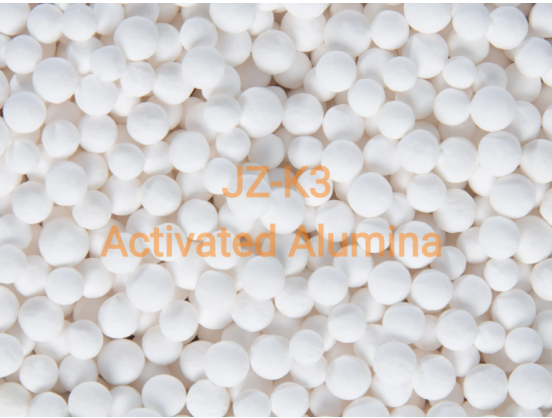
Desiccant regeneration consumes significant thermal or purge energy. Activated alumina must withstand thousands of heating and cooling or pressurization and depressurization cycles without undergoing phase transitions or loss of pore structure. Product series such as JZ-K2 (High-Capacity Activated Alumina) and JZ-K3 (Rapid-Regeneration Activated Alumina) are engineered specifically to lower heat requirements during thermal desorption and speed up moisture release in heatless desiccant dryers. This thermal resilience directly contributes to lower energy consumption during regeneration cycles.
Key Industrial Applications and Operational Integration
Activated alumina serves as a versatile drying agent across diverse manufacturing environments. The physical properties of Joozhou activated alumina match the specific thermodynamic demands of multiple industrial configurations.
Compressed Air and Desiccant Dryer Systems
Compressed air networks supply pneumatic tools, instrumentation, and automated control systems in manufacturing plants. Moisture in these lines leads to valve sticking, cylinder corrosion, and product defects. Joozhou activated alumina is widely deployed in heatless, heated-purge, and blower-purge desiccant dryers. Achieving stable pressure dew points down to -40°C or -70°C, the material ensures dry, high-purity instrument air across continuous production shifts.
Air Separation and Cryogenic Gas Purification
In cryogenic air separation plants, moisture and carbon dioxide must be removed from ambient air prior to liquefaction and distillation. Water freezing at cryogenic temperatures causes blockage in main heat exchangers and cold boxes. Installed in pre-purification units (PPU), high-capacity activated alumina acts as a primary protective barrier, removing bulk moisture before the air enters molecular sieve beds. This dual-bed configuration extends the life of specialized molecular sieves and stabilizes air separation operations.
Natural Gas and Petrochemical Processing
Raw natural gas containing water vapor presents pipe hydrate risks and pipeline corrosion problems during transportation. In natural gas drying units, activated alumina performs effectively under high-pressure conditions to reduce moisture levels to gas pipeline transport specifications. Furthermore, in petrochemical refineries, it serves in liquid hydrocarbon drying, monomer purification, and as an acid-removal agent in transformer oil treatment and refrigerant processing systems.
Industry Trends, Quality Assurance, and Global Capabilities
The global industrial desiccant market is evolving toward increased energy efficiency, longer bed service lives, and lower total cost of ownership. As energy costs rise, industrial gas suppliers and plant operations seek adsorbents that minimize purge air consumption during regeneration and sustain continuous performance without frequent bed replacements.
With over twenty years of dedicated research and development, Shanghai Joozhou New Materials Co., Ltd. operates two wholly-owned manufacturing facilities located in Shanghai and Wuxi. Holding an annual production capacity exceeding 10,000 metric tons and ISO-certified quality management systems, the company maintains strict control over raw material selection, bead forming, drying, and calcination parameters. Automated screening ensures consistent particle size distribution, uniform air flow, and low pressure drop across filled vessels.
Serving clients across more than 80 countries and regions, Joozhou maintains a 99 percent on-time delivery rate supported by comprehensive technical support services. Global industrial gas producers and chemical manufacturing enterprises utilize Joozhou adsorbents in critical process loops, relying on standardized batch testing and long-term mechanical reliability to meet global compliance standards.
Technical Support and Integration Guidelines
Selecting the appropriate adsorbent specification requires evaluating multiple system parameters, including inlet gas flow rate, operating pressure, temperature, relative humidity, and required outlet dew point. Bed geometry, gas velocity, and cycle times further dictate whether standard activated alumina, high-capacity variants, or composite beds incorporating molecular sieves are required.
Joozhou offers technical collaboration from initial engineering design through operational troubleshooting. By performing dynamic adsorption testing and offering customization of bead diameter sizes—typically ranging from 1–2 mm to 5–8 mm—engineers can optimize pressure drop versus mass-transfer rate for specific vessel dimensions. Technical guidance on proper bed loading techniques, such as dense phase loading to prevent void spaces, further maximizes the service life of the installed desiccant.
As industrial facilities continue upgrading gas treatment infrastructure to meet stricter quality and environmental standards, specialized adsorption media remain central to operational reliability. Through material optimization and precise process control, high-performance desiccant solutions provide a dependable path to efficient moisture management across global process industries. To explore technical specifications, application engineering data, and global supply services, visit the official website: https://www.joozhou.com/
Shanghai Joozhou New Materials Co., Ltd.
Shanghai Joozhou New Materials Co., Ltd.
email us here
Legal Disclaimer:
EIN Presswire provides this news content “as is” without warranty of any kind. We do not accept any responsibility or liability
for the accuracy, content, images, videos, licenses, completeness, legality, or reliability of the information contained in this
article. If you have any complaints or copyright issues related to this article, kindly contact the author above.

Media gallery