Refurbished Medical Devices Market to reach USD 42.43 Billion by 2035 at 9.15% CAGR
Refurbished Medical Devices Market to Surge from USD 19.29 Billion in 2026 to USD 42.43 Billion by 2035---Powered by
Press Release Disclaimer: This is a press release distributed through the XPR Media network. It has not been independently verified by our newsroom.
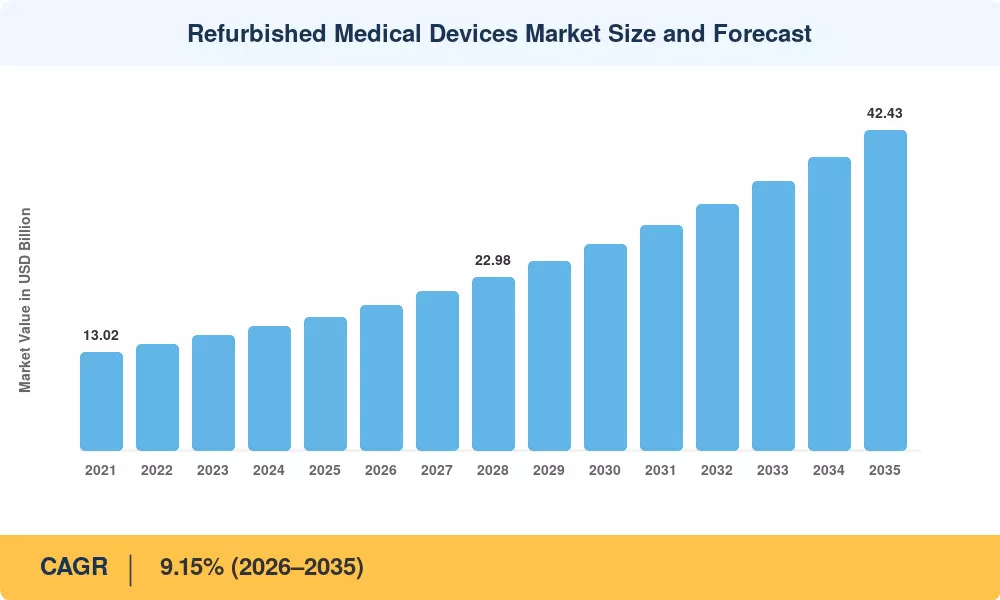

Refurbished Medical Devices Market to Surge from USD 19.29 Billion in 2026 to USD 42.43 Billion by 2035—Powered by Hospital Capital Budget Pressures
NY, CA, UNITED STATES, August 11, 2026 /EINPresswire.com/ — As per Market Research Future, the global Refurbished Medical Devices Market size to reach USD 42.43 Billion by 2035 from USD 19.29 Billion in 2026, at a CAGR of 9.15% during the forecast period 2026–2035. The market base was estimated at USD 17.67 Billion in 2025.
The 9.15% CAGR—anchored by structural healthcare capital reallocation rather than discretionary spending—is driven by three converging forces: persistent hospital capital budget pressures that push procurement teams toward certified second-life equipment, a wave of government green-procurement mandates that legitimize the secondary equipment channel, and an AI-ready imaging upgrade cycle that triggers cascading trade-in volumes, expanding the refurbishable supply pipeline. National governments and multilateral health organizations are amplifying this momentum.
Request A Free Sample:
https://www.marketresearchfuture.com/sample_request/1282
Key Market Trends & Growth Drivers
Hospital Budget Constraints and Capital Reallocation
Growing operating costs are a problem for healthcare systems around the world. According to the American Hospital Association, hospital spending in the United States increased by 17.5% between 2019 and 2024, but reimbursement growth was just 8.2%. Capital equipment committees are forced to choose reconditioned options as a result of this margin compression. 68% of U.S. hospital CFOs actively explored refurbished imaging equipment for at least one capital request during the previous fiscal year, according to a 2024 ECRI Institute survey.
Because certified refurbished CT and MRI machines usually offer 40–55% savings over new-unit list prices without sacrificing diagnostic accuracy, the refurbished medical devices market immediately benefits from this structural change. Each percentage point of hospital margin compression translates into measurable procurement volume for certified second-life equipment, and the capital equipment refresh cycle embedded in routine healthcare operations makes this driver structurally durable through 2035.
Circular-Economy Procurement Mandates
By 2030, 50% of medical equipment purchased by the public sector must be recycled or remanufactured, according to the European Commission’s Circular Economy Action Plan. In the UK, a number of NHS trusts have already integrated sustainability scoring into their procurement processes, giving circular economy attributes up to 15% of the evaluation weight. These legislative signals legitimate the market for refurbished medical devices as part of institutional ESG goals and establish a structural floor for demand for refurbished devices throughout European hospital networks.
Refurbished medical devices carry a 60–70% lower carbon footprint than newly manufactured equivalents, according to lifecycle analysis published by the Ellen MacArthur Foundation. Mandatory ESG disclosures under the EU’s Corporate Sustainability Reporting Directive (CSRD) will require hospitals to quantify Scope 3 emissions from equipment procurement starting in 2026, structurally advantaging the Refurbished Medical Devices Market in European and increasingly in North American procurement decisions.
Emerging-Market Diagnostic Center Expansion
India’s Ayushman Bharat Digital Mission allocated INR 22,000 crore (approximately USD 2.6 billion) to upgrade diagnostic infrastructure in 150,000 health and wellness centers through 2028. Private diagnostic chains such as Metropolis Healthcare and Dr. Lal PathLabs are sourcing refurbished CT, ultrasound, and hematology analyzers to accelerate clinic roll-outs at 35–40% lower capital intensity. A parallel dynamic is playing out in Brazil, where SUS (Sistema Único de Saúde) modernization grants are funneling equipment budgets toward certified refurbished units to stretch limited federal allocations.
China’s State Council directive to equip 1,500 county-level hospitals with advanced diagnostic imaging by 2027 explicitly permits procurement of certified refurbished CT and MRI systems to stretch provincial budgets. National health ministries in Kenya, Nigeria, and Ethiopia are allocating equipment budgets that blend new critical-care systems with refurbished imaging and laboratory devices to maximize facility coverage. The African Development Bank’s USD 3 billion Health Infrastructure Investment Platform creates a dedicated funding channel for medical device procurement that explicitly includes certified refurbished equipment.
AI-Ready Imaging Upgrade Cycle
Hospitals investing in AI-assisted radiology workflows often discover that their existing imaging platforms lack the DICOM throughput, GPU integration, or software compatibility required to run AI inference at the scanner edge. GE HealthCare’s Edison platform and Siemens Healthineers’ AI-Rad Companion both require minimum hardware tiers that exclude pre-2018 scanner vintages. This triggers a cascading equipment refresh: hospitals acquire AI-compatible new systems while trading in older—but still clinically serviceable—units to OEM refurbishment programs, expanding the Refurbished Medical Devices Market supply pipeline.
By 2030, AI-assisted diagnostic imaging is expected to represent over 45% of new radiology installations globally, according to Signify Research. This creates a two-speed Refurbished Medical Devices Market: AI-compatible platforms command premium refurbished pricing, while legacy non-AI systems migrate toward price-sensitive emerging markets. Refurbishers that can retrofit AI software stacks onto existing hardware will capture a differentiated value tier.
Ask for Customization:
https://www.marketresearchfuture.com/ask_for_customize/1282
Market Segment Insights
BY PRODUCT CATEGORY
Medical Imaging Equipment: Dominant segment with ~36.6% revenue share in 2025. Reflecting steady demand for CT, MRI, and ultrasound systems across hospital networks. CT scanners and MRI systems dominate this category because their high new-unit costs (USD 1.0–3.5 million for MRI) make refurbished alternatives—typically priced at 40–55% discounts—particularly attractive to mid-size hospitals and diagnostic centers. The AI-driven imaging upgrade cycle is accelerating trade-in volumes, expanding the refurbishable supply pipeline. Hospital procurement teams treat it as a default first-line option for capital-constrained facilities, and certified refurbishment quality has enabled broad adoption even in cost-sensitive emerging markets.
Operating Room & Surgical Equipment: Fastest-growing product segment at 12.56% CAGR (2026–2035). Driven by ambulatory surgical center build-outs in emerging economies. Ambulatory surgical centers in India, Brazil, and Southeast Asia are driving demand for refurbished anesthesia machines, electrosurgical units, and OR tables as they scale outpatient procedure volumes while managing capital constraints
BY REFURBISHMENT PROVIDER
OEM-Certified Refurbishers: Dominant segment with ~59.3% revenue share in 2025. Reflecting entrenched hospital trust in brand-backed warranty assurance, genuine replacement parts, and software currency. GE HealthCare’s GoldSeal, Siemens Healthineers’ Proven Excellence, and Philips’ Diamond Select programs set the benchmark for certified refurbishment quality. Hospital procurement teams treat OEM-certified units as a default first-line option, and integrated service contracts have enabled broad adoption even in cost-sensitive emerging markets. OEM refurbishers leverage brand recognition, parts access, and integrated service networks as competitive moats.
Independent Refurbishers: Fastest-growing provider segment at 11.39% CAGR (2026–2035). Driven by geographic reach, price competitiveness, and faster turnaround times. Companies such as Soma Technology and Block Imaging compete on willingness to work with legacy platforms that OEMs have discontinued. Independent refurbishers are closing the gap by targeting underserved geographies where OEM service networks have limited reach.
BY END USER
Hospitals: Largest segment with ~58.5% share in 2025 (USD 10.34 Billion). Comprehensive oncology service lines and radiopharmaceutical administration requirements dominate volume. Hospitals remain the primary delivery site for refurbished medical devices due to capital budget optimization needs, specialized biomedical engineering departments, and group purchasing organization contract penetration. Public hospital systems in both developed and developing markets rely on refurbished equipment to maintain diagnostic capacity without exceeding capital expenditure ceilings.
Ambulatory Surgical Centers: Fastest-growing end-user segment at 12.24% CAGR (2026–2035). Outpatient shift and cost optimization drive demand as capital-light expansion strategies align with refurbished equipment procurement. ASCs and community clinics increasingly prescribe refurbished surgical and monitoring equipment to manage procedure volume growth without large capital outlays.
Read Detailed Insights:
https://www.marketresearchfuture.com/reports/refurbished-medical-devices-market-1282
Regional Outlook
North America — Dominant Market (~36.6% Share, 2025)
The United States generates approximately 78.4% of North American Refurbished Medical Devices Market revenue, driven by the mature ecosystem of OEM refurbishment facilities—GE HealthCare operates a 145,000-sq-ft refurbishment center in Milwaukee, and Siemens Healthineers processes over 4,000 units annually in Hoffman Estates, Illinois. Group purchasing organizations such as Vizient and Premier negotiate refurbished equipment tiers into their contract portfolios, giving member hospitals structured access to certified units with standardized warranty terms.
A single policy ecosystem that converted a cost-saving alternative into a mainstream procurement channel with a structural preventive equipment tail. CMS reimbursement frameworks and commercial insurance coverage of diagnostic imaging sustain demand, while community health networks increasingly prescribe refurbished equipment options to manage capital budget constraints. The US dominates through a combination of high per-facility spending, robust GPO contract penetration, and rapid OEM refurbishment program adoption.
Europe — Second Largest (USD 4.84 Billion, 2025)
Europe’s Refurbished Medical Devices Market reflects divergent national strategies—Germany leads regionally with a strong OEM refurbishment base (Siemens, Dräger), contributing 24.1% of regional share, while the UK historically used selective equipment targeting before broadening coverage through NHS sustainability roadmap and procurement scoring at 10.84% CAGR.
France contributes ~14.9% of regional share through AP-HP centralized procurement of refurbished imaging. Italy contributes 11.2% of regional share on SSN cost-reduction directives. Spain holds 8.7% of regional share on regional health authority budget constraints. The Nordic countries are growing at 10.62% CAGR on circular-economy leadership and green public procurement. Russia contributes USD 0.31 Billion on import substitution policies favoring local refurbishers.
Asia-Pacific — Fastest-Growing Region (12.01% CAGR, 2026–2035)
Asia-Pacific is the engine of the Refurbished Medical Devices Market. China holds the largest regional share with ~31.5% of regional revenue, driven by State Council directive to equip 1,500 county-level hospitals with advanced diagnostic imaging by 2027—explicitly permitting procurement of certified refurbished CT and MRI systems to stretch provincial budgets. India is growing at 13.14% CAGR on the back of Ayushman Bharat diagnostic infrastructure expansion.
Japan contributes USD 0.58 Billion through NHI pricing for next-gen imaging equipment at steady pace. South Korea holds 9.8% of regional share on MOHW cost-containment in tertiary hospitals. ASEAN economies are growing at 12.47% CAGR on Thailand and Vietnam hospital construction pipelines. The rest of Asia-Pacific holds 8.4% of regional share on medical tourism for diagnostic capacity investment.
Middle East & Africa — Emerging Opportunity (USD 1.08 Billion, 2025)
The Middle East & Africa is bifurcated between well-funded Gulf states and resource-constrained Sub-Saharan nations. Saudi Arabia leads the region with Vision 2030 healthcare infrastructure expansion, contributing ~28.7% of regional share—NEOM health cluster and procurement guidelines allowing up to 30% of imaging equipment budgets to be allocated toward certified refurbished systems.
The UAE is growing at 10.91% CAGR on medical tourism driving diagnostic capacity investment. South Africa contributes USD 0.19 Billion on NHI pilot procurement of refurbished equipment. Egypt holds 14.3% of regional share on population growth straining public hospital capacity. The rest of MEA is growing at 9.78% CAGR on AfDB health infrastructure lending programs.
South America — Growing Presence (USD 2.21 Billion, 2025)
Brazil anchors South America’s Refurbished Medical Devices Market at ~62.3% of regional revenue, with the Unified Health System (SUS) modernization grants for public hospitals providing a stable demand floor that smooths regional forecasts. Access to high-end refurbished equipment remains limited by import dependencies, though the Brazilian Nuclear Energy Commission has initiated domestic production feasibility studies for select imaging components.
Argentina is growing at 10.28% CAGR on currency constraints favoring refurbished imports. The rest of South America holds steady share on Pan-American Health Organization programs and emerging private clinic networks.
Competitive Landscape and Recent Developments
The Refurbished Medical Devices Market displays medium concentration, with the top five companies holding an estimated 42–48% combined revenue share. The Herfindahl-Hirschman Index sits in the 800–1,100 range, reflecting a mix of multinational OEM refurbishment leaders and specialized independent refurbishers. OEM channel conflict and restrictive service agreements are gradually fragmenting branded segments, though pipeline innovation in AI-compatible upgrade pathways sustains competitive moats for first-movers.
The competitive landscape is stratified between OEM-certified refurbishers serving global hospital networks, independent refurbishers consolidating the secondary equipment segment, and digital marketplace operators capturing transaction volume through integrated logistics and financing services.
KEY COMPANIES AND RECENT MILESTONES
GE HealthCare (2024–2025): Maintains leadership with GoldSeal certified CT, MRI, ultrasound, and patient monitoring equipment, commanding ~12–15% of global Refurbished Medical Devices Market revenue. Largest OEM refurbishment network with integrated financing solutions. Premium brand positioning in specialty segments offsets independent price compression in competitive markets.
Siemens Healthineers (2024–2025): Proven Excellence imaging and laboratory diagnostics reinforce the European refurbishment hub positioning, holding ~10–13% of global revenue. The company benefits from AI-compatible upgrade pathways and processes over 4,000 units annually in Hoffman Estates, Illinois.
Philips Healthcare (2024–2025): Diamond Select MRI, CT, and patient monitoring reinforce the strong cardiac imaging refurbishment positioning, holding ~8–11% of global revenue. Subscription models and software currency programs differentiate the portfolio in competitive tenders.
Future Outlook: 2026–2035
By 2030, AI-integrated diagnostics and smart refurbishment will become the operating system of secondary medical device management. The convergence of digital marketplace platforms and AI-driven equipment grading will reshape the Refurbished Medical Devices Market through the late 2020s. By 2030, an estimated 45% of newly installed radiology platforms will undergo AI-assisted workflow integration, creating a diagnostic-therapeutic revenue loop that channels trade-in volumes into the refurbishment pipeline.
Machine-learning models that integrate equipment telemetry, maintenance logs, and utilization biomarkers can recommend optimal refurbishment sequencing for individual devices. Digital platforms such as DOTmed processed over USD 1.2 billion in transaction volume in 2024, and the next phase involves integrated logistics, financing, and equipment-grading services.
More Related Research Insights:
https://www.marketresearchfuture.com/reports/flexible-endoscopes-market-11685
https://www.marketresearchfuture.com/reports/electron-microscope-market-6656
https://www.marketresearchfuture.com/reports/digital-therapeutics-market-6492
https://www.marketresearchfuture.com/reports/first-aid-market-28904
https://www.marketresearchfuture.com/reports/injectable-drug-delivery-devices-market-1211
https://www.marketresearchfuture.com/reports/medical-devices-market-2869
https://www.marketresearchfuture.com/reports/biopsy-devices-market-2250
https://www.marketresearchfuture.com/reports/longevity-market-42067
https://www.marketresearchfuture.com/reports/vaccine-adjuvants-market-1098
https://www.marketresearchfuture.com/reports/tissue-engineering-market-2134
Larry Wilson
WantStats Research And Media Pvt. Ltd.
+1 855-661-4441
email us here
Visit us on social media:
LinkedIn
Facebook
YouTube
X
Legal Disclaimer:
EIN Presswire provides this news content “as is” without warranty of any kind. We do not accept any responsibility or liability
for the accuracy, content, images, videos, licenses, completeness, legality, or reliability of the information contained in this
article. If you have any complaints or copyright issues related to this article, kindly contact the author above.

Media gallery