Unmanned Underwater Vehicle (UUV) Market to Approach US$ 25.9 Billion by 2035 as Defense and Ocean Data Needs Surge
UUV market set to grow from US$ 4.9 Billion in 2024 to US$ 25.9 Billion by 2035 at a 16.6% CAGR, driven by defense,
Press Release Disclaimer: This is a press release distributed through the XPR Media network. It has not been independently verified by our newsroom.
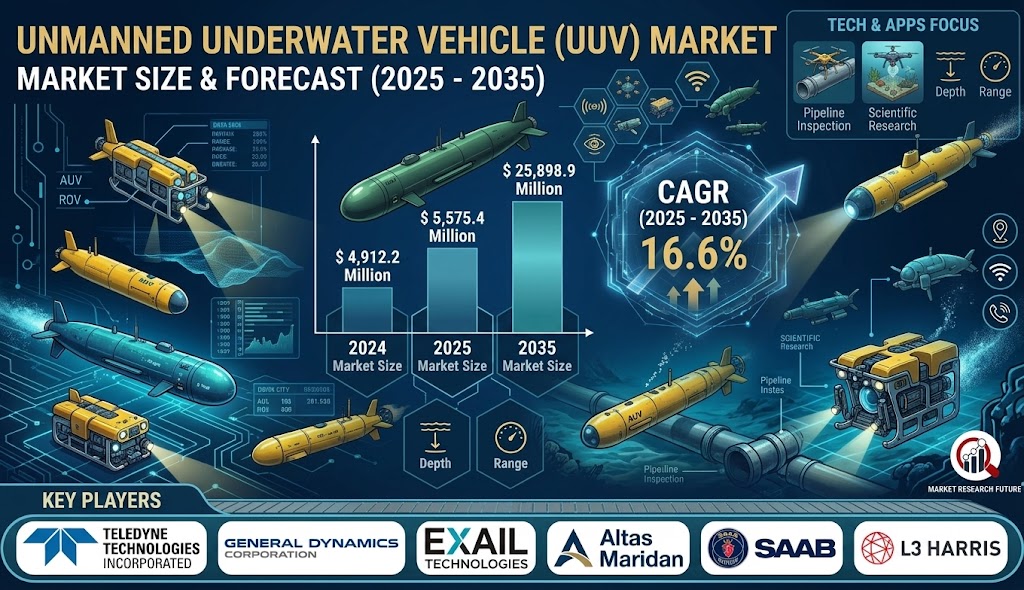

UUV market set to grow from US$ 4.9 Billion in 2024 to US$ 25.9 Billion by 2035 at a 16.6% CAGR, driven by defense, energy, and ocean-research demand worldwide
NEW YORK, NY, UNITED STATES, August 27, 2026 /EINPresswire.com/ — The global Unmanned Underwater Vehicle (UUV) market is on track for a dramatic decade of expansion, with industry estimates placing its value at roughly US$ 4.9 billion in 2024 and projecting growth to nearly US$ 25.9 billion by 2035. That trajectory implies a compound annual growth rate in the neighborhood of 16.6% across the 2025–2035 forecast window — a pace that reflects how central underwater autonomy has become to national defense strategies, offshore energy operations, and marine science programs around the world.
Once a niche category populated mainly by research labs and naval procurement offices, the UUV space has broadened considerably. Today it spans compact, backpack-portable drones used for harbor inspections to large, long-endurance platforms capable of operating autonomously for weeks at extreme ocean depths. That diversification is precisely what analysts point to when explaining the market’s sustained double-digit growth outlook.
A Market Driven by Necessity, Not Novelty:
Several converging forces are pushing procurement budgets toward unmanned underwater systems rather than traditional crewed alternatives.
Chief among them is the growing need for persistent, round-the-clock observation of submerged and coastal waters. Unlike crewed missions, which are constrained by fatigue, safety limits, and cost, unmanned platforms can loiter underwater for extended stretches, gathering continuous data on everything from vessel traffic to environmental conditions. This capability has become especially valuable to coast guards and naval forces monitoring exclusive economic zones, shipping lanes, and undersea infrastructure such as pipelines and communications cables.
Request for Free Sample of Report: https://www.marketresearchfuture.com/sample_request/11125
Defense spending is another major pillar. Navies worldwide are investing heavily in underwater drones for anti-submarine warfare, mine countermeasures, covert reconnaissance, and intelligence-gathering missions where sending a crewed vessel would be operationally risky or diplomatically sensitive. Because these systems can operate independently and relay real-time data, they are increasingly viewed as a force multiplier rather than a supplementary tool.
The offshore energy sector adds further momentum. Oil and gas operators use UUVs to inspect subsea pipelines, wellheads, and platforms in place of human divers, reducing exposure to hazardous underwater conditions while also cutting inspection costs. As offshore exploration pushes into deeper and more remote waters, the appeal of sending a machine rather than a person only grows.
Marine science and environmental monitoring round out the demand picture. Oceanographers, conservation groups, and government agencies increasingly rely on UUVs to study reefs, track marine ecosystems, and monitor water quality — tasks that benefit from the vehicles’ ability to reach depths and durations impractical for human divers or surface vessels.
That said, the industry is not without friction points. High acquisition and operating costs, a shortage of personnel trained to operate and maintain these systems, and payload limitations on smaller vehicle classes remain real constraints on faster adoption, particularly among smaller operators and emerging-market buyers.
Technology itself is also acting as a growth catalyst rather than simply a feature upgrade. Improvements in battery chemistry, including next-generation lithium-sulfur cells, alongside continued refinement of fuel-cell propulsion, are extending mission durations well beyond what was possible even five years ago. That shift matters for deep-sea applications, where the cost of retrieving and redeploying a vehicle can rival the cost of the mission itself. Manufacturers are responding by designing modular vehicles with interchangeable payload bays, allowing a single hull to be reconfigured with different sensor suites, cameras, or manipulator arms depending on mission needs — a differentiator that lets operators spread the cost of one platform across multiple mission types rather than buying specialized vehicles for each task.
Autonomy Takes the Lead, But Tethered Systems Still Dominate Revenue:
The market is typically segmented by vehicle type into Remotely Operated Vehicles (ROVs) and Autonomous Underwater Vehicles (AUVs), and the two categories serve distinctly different purposes.
ROVs remain the largest revenue contributor. Connected to a surface vessel by a tether that supplies power and transmits commands and data, ROVs give operators direct, real-time control — a critical feature for tasks like structural inspection, repair work, and precision manipulation using onboard robotic arms. Their reliance on constant human oversight makes them the preferred choice for jobs demanding accuracy and adaptability in the moment.
AUVs, by contrast, represent the segment expected to grow fastest. These untethered vehicles rely on onboard navigation, sensors, and increasingly sophisticated software to complete missions without direct human control, making them well suited to long-duration work such as seafloor mapping and wide-area environmental surveys. Advances in edge computing and AI-driven navigation are reducing the need for constant human supervision, enabling AUVs to handle tasks like obstacle avoidance and adaptive route planning largely on their own — a trend that is reshaping how operators think about mission design.
By vehicle class, the market is further divided into man-portable systems (roughly 10–20 hours of endurance), lightweight vehicles (20–40 hours), heavyweight vehicles (40–80 hours), and extra-large platforms rated for more than 80 hours of continuous operation. Man-portable UUVs currently account for the largest share, prized for their ease of deployment by a single operator or small team in coastal surveys and rapid-response scenarios. Lightweight vehicles are expected to see the fastest growth, as they strike a balance between portability and the added endurance needed for more complex missions like offshore infrastructure inspection.
Depth capacity is another key differentiator. Vehicles rated for depths beyond 1,000 meters currently generate the most revenue, built to withstand extreme pressure for deep-sea exploration, pipeline inspection, and scientific research in the ocean’s most remote reaches. Meanwhile, systems rated for up to 1,000 meters are forecast to grow the fastest, as offshore energy and research applications increasingly push into deeper but not necessarily extreme-depth waters.
Speed segmentation splits the market into vehicles operating below 5 knots — prioritized for endurance, payload capacity, and precision over speed, and commonly used in seafloor mapping and environmental data collection — and higher-speed vehicles exceeding 5 knots, which are gaining ground for time-sensitive missions such as search-and-rescue and rapid military deployment.
Power source is an increasingly important consideration as mission profiles lengthen. Conventional lithium-based batteries remain the dominant power source thanks to their simplicity, affordability, and compatibility with established supply chains, though they can limit runtime on extended missions. Fuel cell technology, typically hydrogen-based, is the fastest-growing power category, offering substantially longer endurance for deep-water and long-range operations — even as the complexity of safely storing and handling hydrogen underwater remains a technical hurdle.
On the applications front, Military & Defense/Security represents the largest end-use segment, encompassing maritime border surveillance, anti-submarine warfare, and monitoring for illegal activity at sea. Within this segment, navies are placing particular emphasis on anti-submarine warfare capability, deploying UUVs to detect, track, and shadow adversary submarines in support of broader naval defense planning. Coastal and border-security applications are equally significant, with unmanned vehicles increasingly tasked with monitoring exclusive economic zones for smuggling, unauthorized fishing, and other maritime security threats that would be difficult or costly to police with crewed patrol vessels alone.
Environmental Protection & Monitoring is the fastest-growing application, reflecting rising investment in habitat research, water-quality sampling, and conservation efforts. UUVs deployed for habitat research are increasingly used to study sensitive ecosystems such as coral reefs and seamounts, generating data that feeds directly into conservation planning and environmental management decisions. Water-sampling missions, in which vehicles collect samples from depths impractical for human divers, are similarly gaining traction among researchers studying pollution levels and broader aquatic health trends. Other notable applications include oil and gas infrastructure inspection, oceanographic research, archaeology and underwater exploration, and search-and-salvage operations — each representing a smaller but steadily growing share of overall market demand as commercial and scientific users increasingly recognize the cost and safety advantages of unmanned platforms over traditional crewed alternatives.
“Regional Momentum: North America Leads, Asia-Pacific Accelerates”
North America currently anchors the global UUV market, underpinned largely by sustained U.S. Department of Defense procurement. Government contracts have historically provided manufacturers with a stable revenue base, complemented by commercial demand from research institutions and oil and gas companies for pipeline inspection and environmental monitoring work.
Europe represents a mature and innovation-driven market, with the United Kingdom, Germany, and France serving as hubs for both established manufacturers and a dense ecosystem of specialized small and mid-sized firms developing next-generation underwater technology for defense, energy, and research applications.
Asia-Pacific is widely regarded as the fastest-growing region in the global UUV landscape. Rising defense budgets, heightened maritime security concerns, and falling technology costs are driving substantial investment from China, Japan, South Korea, and Australia, positioning the region as an increasingly important battleground for manufacturers competing for market share.
South America’s growth is being fueled by expanding offshore oil and gas activity, marine research initiatives, and environmental monitoring programs, with Brazil, Mexico, and Colombia emerging as notable investors in underwater capability.
Meanwhile, the Middle East and Africa region is seeing gradual momentum tied to offshore energy exploration and maritime security priorities, with countries such as Saudi Arabia, the United Arab Emirates, and South Africa investing in UUVs for inspection, mine countermeasures, and marine research applications. A recurring theme across the region is the demand for cost-effective solutions that can deliver operational value without the capital intensity associated with more advanced deep-water systems, making lighter, more affordable vehicle classes especially attractive to buyers in these markets.
Taken together, these regional dynamics illustrate a broader pattern: while North America and Europe continue to anchor the market in absolute revenue and technological leadership, the fastest growth is concentrated in regions where maritime security concerns and offshore resource development are only beginning to accelerate — a divergence likely to reshape competitive strategy as manufacturers expand distribution into higher-growth markets.
Competitive Landscape:
The UUV market remains fragmented and highly competitive, with global defense contractors, specialized marine technology firms, and regional players all vying for position. Leading companies shaping the competitive landscape include Teledyne Technologies Incorporated, General Dynamics Corporation, Exail Technologies, Atlas Maridan, Saab AB, L3Harris, Boston Engineering, Boeing, and Advanced Navigation, among others.
Recent industry activity underscores how quickly the competitive field is evolving. Saab has moved forward with concept development work commissioned by Sweden’s defense procurement agency, aimed at advancing next-generation underwater capability for future submarine-related systems. Separately, L3Harris has partnered with sonar and sensor specialists to integrate advanced imaging technology onto its autonomous underwater vehicle platforms, supporting NATO-aligned missions spanning search and rescue, mine countermeasures, and oceanographic survey work. In the commercial sector, Exail has supplied an unmanned surface vehicle to a major subsea services provider, part of a broader push to reduce vessel time and lower the carbon footprint of offshore survey operations.
Vendors across the board are competing on cost, reliability, and product performance, all while navigating a regulatory landscape shaped by evolving government policy and environmental standards. Analysts note that companies able to combine competitive pricing with technical dependability are best positioned to capture share in an increasingly crowded field.
Beyond the largest defense-oriented contractors, the market also includes a long tail of smaller, highly specialized firms developing niche technology — from advanced sonar and imaging systems to novel propulsion and power solutions — that often partner with, or are acquired by, larger players seeking to round out their product portfolios. This dynamic has made partnerships and technology-sharing agreements almost as important to competitive positioning as in-house research and development. Larger firms increasingly view collaboration with smaller innovators as a faster route to integrating cutting-edge sensor and navigation technology than building every capability internally, a trend reflected in the growing number of joint ventures and integration partnerships announced across the sector in recent years.
Looking Ahead:
Industry watchers expect the UUV sector to sustain its roughly 16.6% compound annual growth rate through 2035, propelled by rising computing power, improved sensor and imaging technology, and expanding commercial-sector adoption beyond the market’s traditional defense base. Emerging opportunities include the deeper integration of artificial intelligence into autonomous vehicle navigation, next-generation sensor and imaging systems, and expanded use cases in deep-sea exploration and resource mapping.
As the technology matures and costs gradually decline, stakeholders across defense, energy, and scientific research are expected to deepen their reliance on unmanned underwater systems — reinforcing the sector’s position as one of the more consequential growth stories in maritime technology over the coming decade.
For investors and industry participants, the implications extend well beyond the headline growth figures. The shift toward autonomy, modular design, and longer-endurance power systems suggests that competitive advantage in this market will increasingly hinge on software and systems integration capability rather than hull manufacturing alone. Companies that can pair reliable hardware with intelligent navigation, data processing, and mission-planning software are likely to command a growing share of value as the market matures. At the same time, the widening set of use cases — from national defense to offshore energy to marine conservation — means that the addressable market for UUV technology is no longer confined to government procurement budgets, but increasingly includes commercial and scientific buyers with their own distinct purchasing cycles and requirements.
Stakeholders evaluating opportunities in this space should also weigh the persistent operational challenges the sector faces, including the high upfront cost of advanced platforms, the ongoing shortage of trained operators and technicians, and the technical complexity of emerging power systems such as hydrogen fuel cells. How effectively individual companies and national programs address these constraints is likely to determine which players capture the largest share of the growth still ahead.
Browse More Reports:
Underwater Drone Market
https://www.marketresearchfuture.com/reports/underwater-drone-market-12257
Autonomous Underwater Vehicle Market
https://www.marketresearchfuture.com/reports/autonomous-underwater-vehicle-market-7384
Armored Unmanned Underwater Vehicle Market
https://www.marketresearchfuture.com/reports/armored-unmanned-underwater-vehicle-market-3851
Market Research Future
Market Research Future
+1 855-661-4441
sales@marketresearchfuture.com
Legal Disclaimer:
EIN Presswire provides this news content “as is” without warranty of any kind. We do not accept any responsibility or liability
for the accuracy, content, images, videos, licenses, completeness, legality, or reliability of the information contained in this
article. If you have any complaints or copyright issues related to this article, kindly contact the author above.

Media gallery